
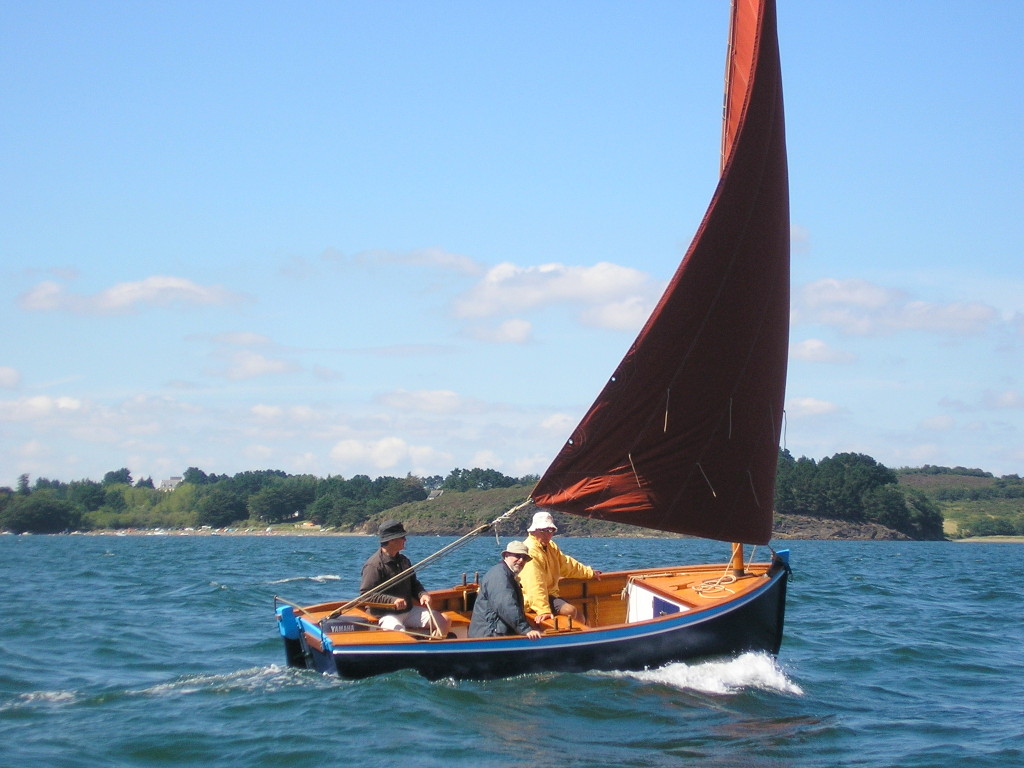
Traditional sail boat, 4.5 m long, with outboard motor well, strip planked over laminated frames
| Hull length / waterline | 4.50 / 4.24 m | Sail area | 14 m² | ||
| Breadth / waterline | 1.85 / 1.64 m | Outboard motor | 6 hp | ||
| Draught | 0.45 / 0.98 m | Design category / Crew | C4 / D5 | ||
| Light weight | 480 kg | Building time | 750 hours |
Attention: this boat may be built only with full size patterns in addition to the plan.
Many different rigs may be chosen according to your specific needs, from the very simple lug sail to the well-canvassed gaff cutter (see drawings). Ebihen 15 is fitted with a metal centreboard that allows excellent stability and good windward ability.
A well for the outboard motor is built aft of the cockpit, with the motor handle at helmsman reach. The propeller is just ahead of rudder for good manoeuvrability. A 4 strokes – 3 to 6 hp – motor may be installed.
Ebihen 15 can be built and stored during winter time in a common garage. It is of course trailerable. The first boat of the series was strip-planked, with laminated frames and backbone, and almost no plywood. It is a beautiful wooden construction. The clinker version is mainly made of plywood, for the hull planking but also backbone and transverse bulkheads, then much more easy to build by a first-time amateur. The clinker version is built from a dedicated plan package.
I invite you to visit the blog of Stan Richards (California) describing the construction of an Ebihen 15 (clinker)
A longer version (4.8 m), with same breadth and depth, is also available. She is named Ebihen 16.
Ebihen 15 plans are also available for a traditional carvel construction. Ask the designer.
Francois Vivier –
Il y a en effet des caissons à l’intérieur du puits moteur qui ont pour objet principal de réduire le volume d’eau dans le puits, en laissant uniquement l’espace nécessaire pour l’arbre du moteur. En outre, ces caissons peuvent participer au volume de flottabilité.
Laurent Imbert –
Cher François Vivier
J’ai construit en 1994 un Ilur à clins sur votre plan. Hélas il a dû être détruit en 2024 pour cause de pourrissement du CP qui s’est imprégné d’eau suite à des avaries, incidents…J’ai acheté d’occasion en 2025 un Ebihen 15. J’ai encore peu navigué avec. Je m’interroge sur la configuration du puits moteur. D’abord il présent quelques fissures près de la quille. Je vais les boucher à l’époxy chargé. D’autre part je ne comprends pas bien l’utilité du coffrage autour du puits. Je vois bien l’utilité des coffres latéraux qui sont remplis de mousse de flottabilité mais je ne comprends pas celle du coffre qui entoure le moteur en contrebas des coffres latéraux . Est-il vide ? Pourquoi est-il percé de deux trous donnant sur le cockpit ?
Je vous serai très reconnaissant de m’éclairer sur ce point.
Laurent Imbert
49730 Montsoreau