Lotca : expedition down the Danube river
- Post author:Francois Vivier
- Post published:20 August 2025
- Post category:Custom sail-boats / News / Reconstruction
- Post comments:0 Comments
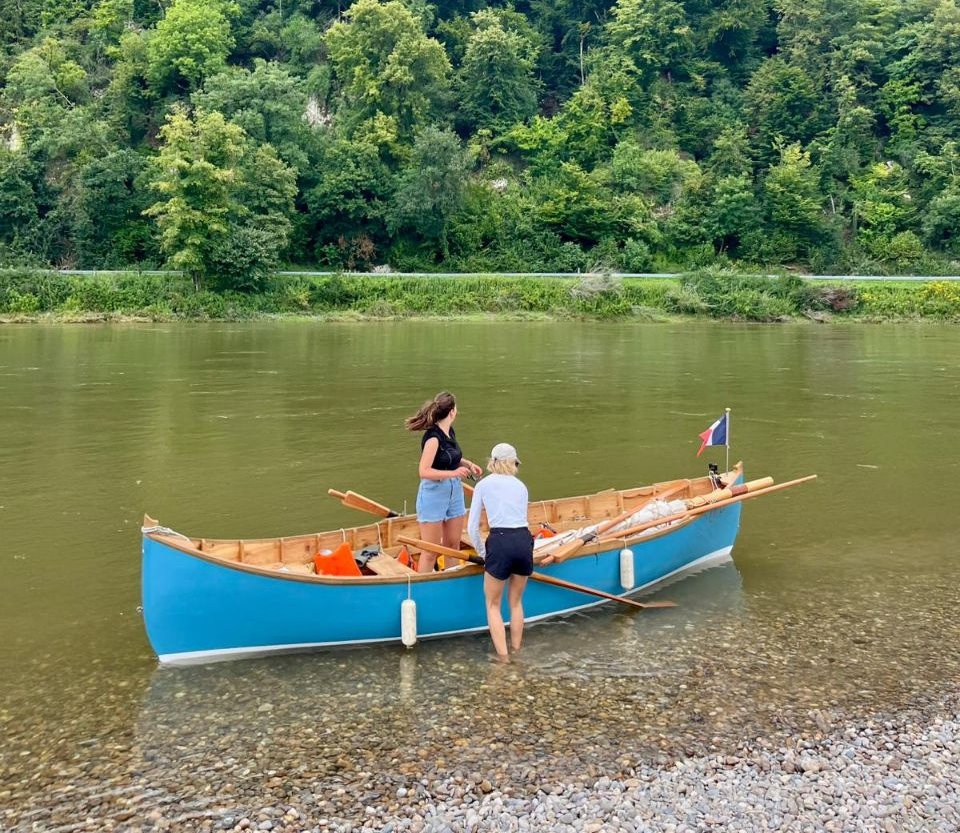
Agathe and Marion had completed several river canoe trips in France, including one down the Loire. This gave them the idea for a more ambitious expedition: to travel down the Danube, with the ultimate goal of reaching Istanbul via the Black Sea. They submitted an application to La Guilde and were awarded an adventure grant and partial funding. Canoes were out of the question. A more serious boat was needed, one that could be rowed on the upper Danube, sailed or rowed on the lower Danube, and sailed on the Black Sea. Agathe and Marion discover the existence of a traditional boat from the lower Danube: the Lotca. Their search for a second-hand Lotca proves unsuccessful. A Swampscott dory (an American boat) was for sale on the Skol ar Mor website. Contact was made with the traditional boatbuilding school in Mesquer (Loire-Atlantique), which offered a better option: building a Lotca.
These boats were mainly used for fishing, propelled by oars and poles in shallow waters. They had a small spritsail for downwind sailing, steered with a stern oar. Internet research, followed by a trip to Romania by Boris Proutzakoff, a shipwright trainer, enabled us to gather some plans and lots of photos. That’s where I came in, to design the expedition’s Lotca, as faithful as possible to the traditional type.
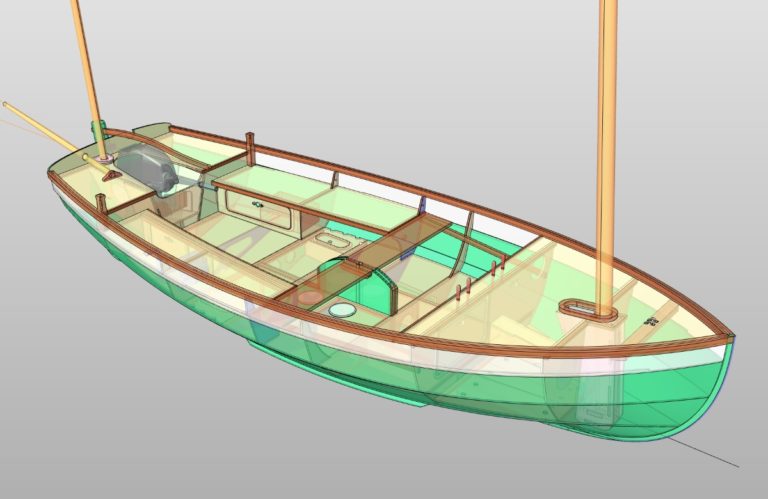
The dimensions of this Lotca were defined according to the expedition project: a good rowing boat for two people, with enough volume to carry the necessary equipment. The hull lines are symmetrical, fore and aft, but more raised at the bow. The bottom is very flat. We agreed on more generous sails, with a rudder and a side leeboard of the type used on batelleku, traditional Basque boats. The construction is made of carvel hull planking on sawn frames. The absence of a centreboard case means that it is possible to spend nights on board when it is not possible to pitch a tent nearby. An important part of my role as a naval architect was to define the volume and location of the buoyancy elements that would allow the boat to be righted without outside assistance and comply with the ISO safety standards.
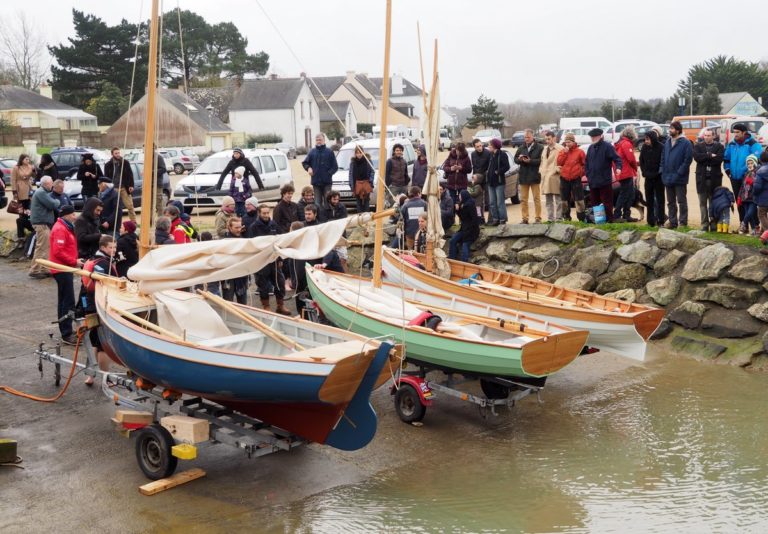
The Lotca was launched, like other Skol ar Mor boats, on Saturday 26 July 2025. Rowing and sailing trials were carried out in the following days, as well as a righting test after capsizing. A week later, the boat and its crew set off for Ulm in Germany, the starting point of the expedition.
This is where the adventure begins, with long days of rowing, mostly in the sweltering heat of this scorching August. Agathe and Marion usually sleep under tents, on or near the beach. Sometimes they are allowed to stay in a sailing club or a disused hotel. They only sleep on board twice. The sail is hardly used, as the wind is too weak, irregular or contrary. The leeboard is difficult to set up and hold in place, as it is not sufficiently adjusted. This seriously impairs the ability to sail upwind and tack. The trip down the Danube is therefore mainly done by rowing, which is a great achievement. In the Black Sea, they manage to cover a hundred miles, measured in a straight line, despite the difficulty of making effective progress under sail. The adventure ends in Mangalia, the last Romanian port before reaching the Bulgarian border. Congratulation!
You can follow Agathe and Marion’s adventure on Polarsteps.